Operating Blue Canoe · 3 of 4
A Telephone Should Not Need a PBX
From an open-box desk phone to a working business number: establishing a small SIP configuration, testing it and hardening it one change at a time.
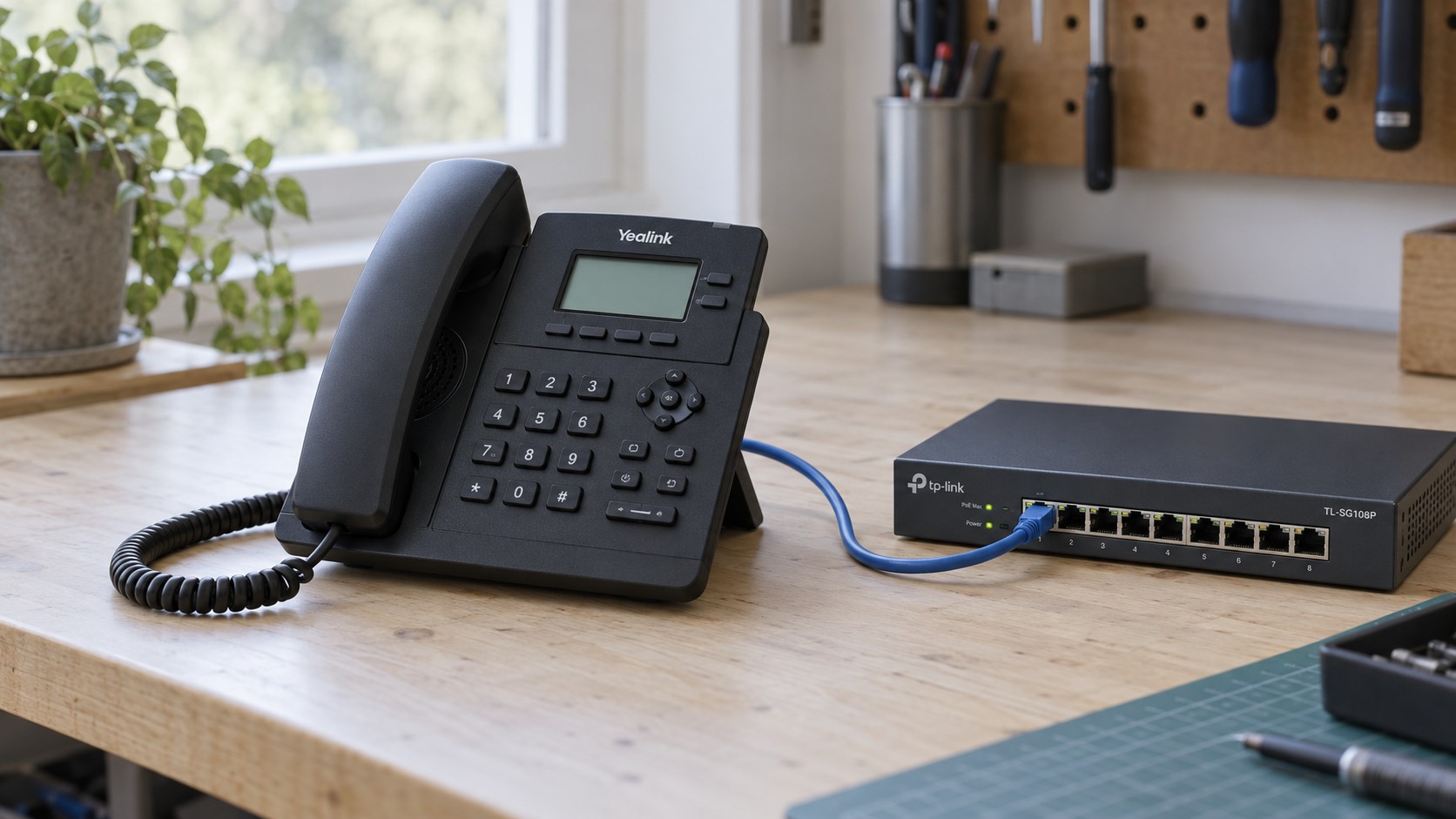
The requirement was ordinary: a geographically local business number that rings on a desk during working hours, without forwarding every call to a mobile.
An unused, open-box Yealink T31P from eBay cost under £30. A TP-Link PoE switch supplied power and networking through one cable. The phone joined the backup network behind TOK, our MikroTik router. Andrews & Arnold supplied the SIP service and an 01476 geographic identity.
The purchase was the easy part. A phone on a desk is not yet evidence of a working telephone service.
Establish what arrived
We inspected the handset before changing it. Its firmware was 124.86.0.40, and the upgrade needed an intermediate release rather than a single jump:
124.86.0.40 → 124.86.0.118 → 124.87.0.15
Configuration backups preserved the state around the changes. Both default web accounts, Admin and User, received new passwords. A static DHCP reservation gave the handset a predictable address while leaving network configuration with the router.
These were small preparations, but they removed avoidable uncertainty. We knew which firmware was running, where to find the phone and which configuration we could return to.
Inspect the network before opening it
SIP has a reputation for inviting elaborate network adjustments. That is not a reason to make them before examining the network already in place.
We inspected TOK's configuration and found its SIP ALG enabled. This helper can intervene in SIP traffic; we disabled it before establishing the working baseline.
We deliberately created no inbound SIP port forwards. There was no STUN configuration and no PBX. The handset registered directly with A&A through the existing outbound connection and NAT.
That was the smallest arrangement worth testing. Adding components at this point would have made a failure harder to explain without first demonstrating that they were needed.
A registration is only the first test
A&A accepted the handset's registration. That established contact with the service, but it did not establish that a caller could reach us or that a conversation would work.
An inbound call rang the desk phone. Two-way audio established that the media path worked in both directions for that call. An outbound call then exercised the other direction of calling.
Those results belonged together. A registration indicator, a ringing handset and audible speech each answer a different question. None should quietly stand in for the others.
Harden the configuration that works
With a working baseline established, we tightened the service one change at a time.
The provider-side source-IP restriction limited outgoing SIP use to TOK's public address. Chargeable international calling was disabled, and a £5 spending warning was configured. The warning was an alert, not a claim that spending could never exceed £5.
The BCHours profile set desk-phone hours to 09:00–16:00, Monday to Friday, with voicemail-to-email for messages. This placed the business-hours decision at the service rather than requiring another system beside the handset.
Configuration and observation still needed separate labels. The hours and voicemail routing were configured; the real 16:00 transition remained a follow-up check. Successful daytime calls did not prove that the phone would stay silent and voicemail would take over at closing time.
Recovery is part of commissioning
We rebooted the handset. It re-registered, and fresh inbound and outbound calls worked without intervention.
That closed an important gap: the service could recover after a handset restart, rather than depending on the session in which it had first been configured. It did not prove recovery from every router, provider or network failure.
The useful result was a small, understood configuration with recorded call tests and a demonstrated restart. Further changes could begin from that evidence instead of being piled onto an unexplained success.
After two firmware upgrades and some careful commissioning, we had recreated a familiar convenience: a business telephone on a desk. Keeping it simple still required proving that the simple arrangement worked.